Kitchen Tools review
Escali Candy Thermometer, Fridge Dial and Timer, Reviewed
Three small Escali gauges, one for sugar and frying, one for the fridge and freezer, one for the clock. Which are worth the shelf space?
The short version
Escali
Escali AHC2 Candy Thermometer
Recommended, with caveats4.4 (593 ratings) 50+ bought in past month
- Best for jam, pralines and deep frying in a deep pot
- Skip it if you cook in shallow pots or can't check its accuracy.
Escali
Escali AHF1 Fridge Freezer Dial
We recommend4.4 (116 ratings)
- Best for a chest freezer, spare fridge or mini fridge
- Skip it if you want an alarm or a record of overnight highs.
Escali
Escali DR6 Four Event Timer
Recommended, with caveats4.3 (63 ratings)
- Best for cooks running several dishes at once
- Skip it if you time one thing and want simple setup.
Three cheap gauges for numbers you can't see
Most mistakes with heat and time come down to a number nobody checked. The oil is at temperature or it isn't, and the fridge is cold enough or it only feels cold. Three inexpensive Escali instruments settle those questions: the AHC2 deep fry and candy thermometer, the AHF1 refrigerator and freezer thermometer, and the DR6 four-event timer.
None of them has a menu to get lost in. The AHC2 is an analog dial on a 12-inch stainless steel probe, with zones printed for jelly, soft ball, firm ball, hard ball, hard crack, caramel and deep frying. The AHF1 is a 2.875-inch dial that stands on a shelf or hangs from a rack. The DR6 is a small plastic digital timer that tracks four events at once and sticks to the fridge by magnet.
They suit different cooks. The AHC2 is for jam, pralines and fried food in a deep pot, and the AHF1 is for anyone who wants to know what a fridge or a spare freezer is doing. The DR6 is for the cook with several things going at once.
Their weak spots differ too. Reviews of the AHC2 include a unit that read 15 degrees off and another that read far higher than a second thermometer in the same oil. A few DR6 buyers report missing parts or a setup that confuses them.
We read the three product pages, the specs and the buyer reviews we could find, then set the three side by side. For fridge and freezer temperatures we rely on the FDA, and for checking a thermometer we rely on the USDA Food Safety and Inspection Service. We name them wherever they speak.
Escali · deep fry and candy thermometer
A long probe with candy zones, and an accuracy catch
| Color | Silver |
|---|---|
| In the box | Thermometer |
| Model | Escali Deep Fry/Candy Thermometer |
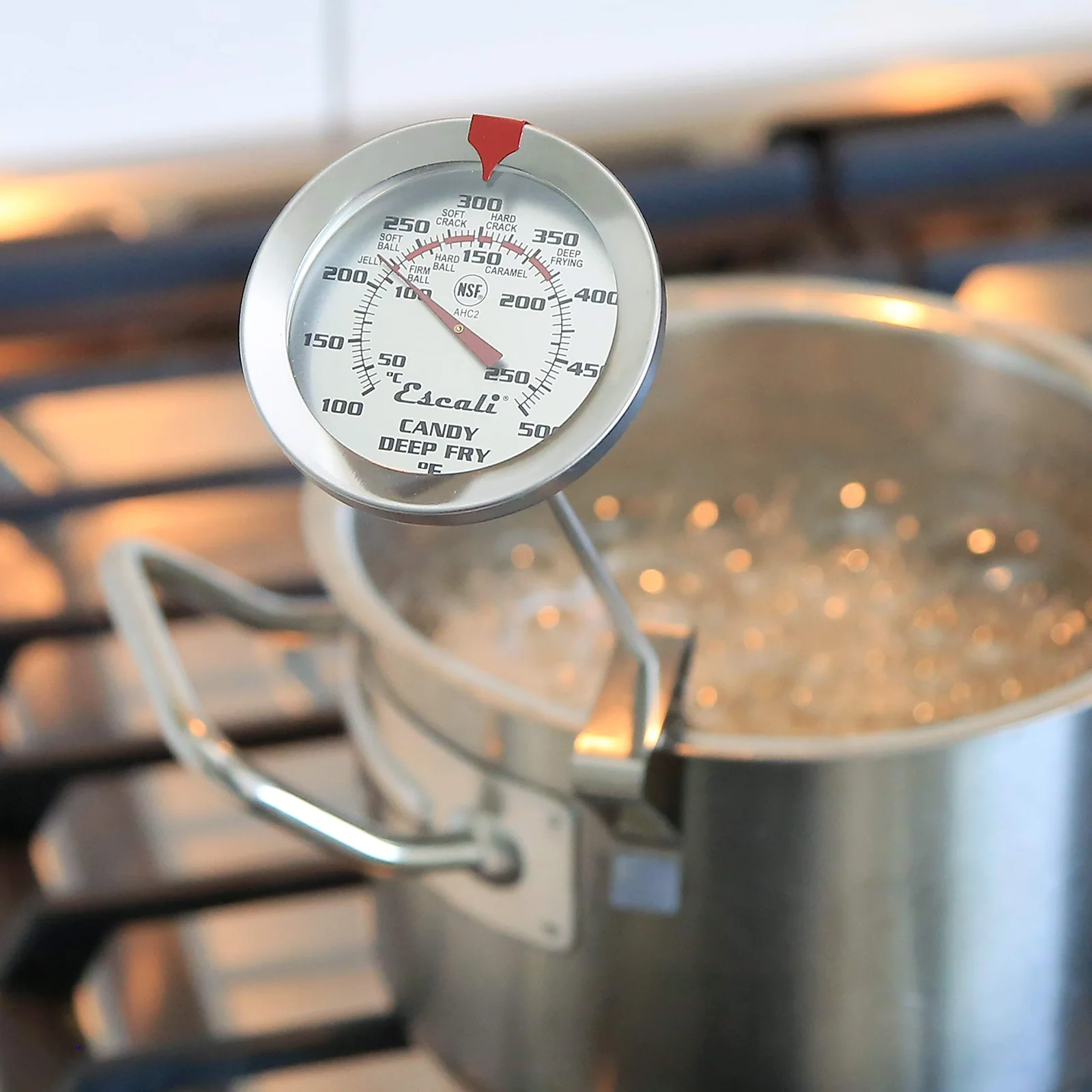
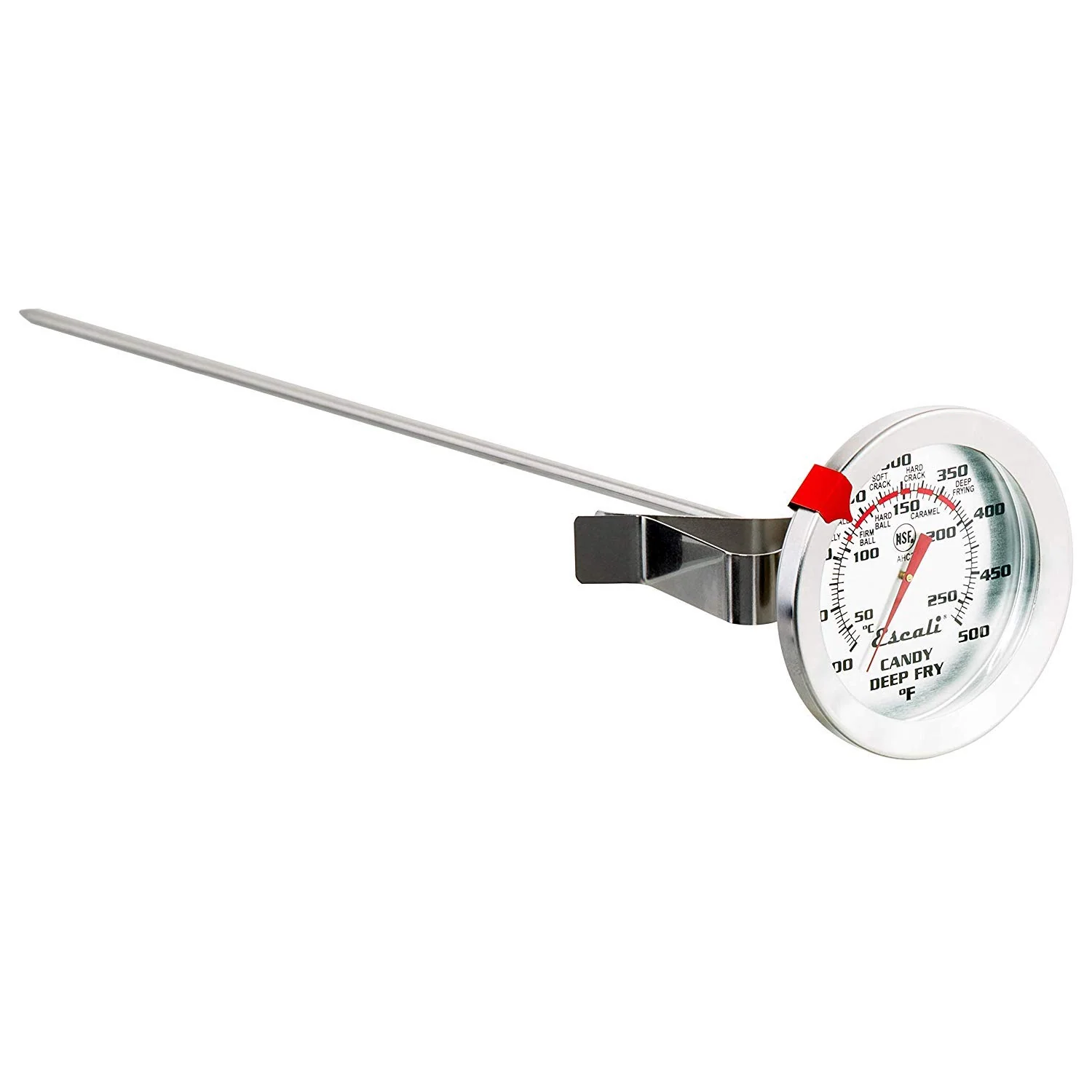
The AHC2 is an analog dial on a 12-inch stainless steel probe, with a 2.5-inch face. Escali gives its range as 100°F to 500°F, which covers sugar work and deep frying but nothing cooler. The brand lists a 500 millisecond response time and calls it a fast reading system.
The face is printed with zones for jelly, soft ball, firm ball, hard ball, hard crack, caramel and deep frying. You watch the needle enter a zone instead of memorizing numbers. An adjustable metal indicator rotates around the dial to mark a target, and a reviewer who makes jelly loved that arrow.
The same reviewer says the long stem lets them see the dial above the steam. A stainless clip holds the probe in the pot for hands-free reading, and another buyer says it keeps the thermometer in the right place, away from the side of the pot. A third reviewer found the dial easy to read but warns that in a shallow pot it feels top heavy and may not stay put.
Size is the other catch. One buyer who made rock candy liked the thermometer, but wrote that the smaller size is better for a regular saucepan. If your pot is a small saucepan, a 12-inch probe may be more instrument than you need.
Care is where Escali's page disagrees with itself. One bullet calls the thermometer dishwasher safe and usable in an oven or grill, while the details list says hand wash only.
We would follow the stricter line. A reviewer adds that food can lodge in the clip, and then you need a small brush to clean it out.
Off by nearly 150F in 300F oil (reading 450 ish).
Accuracy is the real question. Three of the nine written reviews we read are bad ones. One Canadian buyer says it read about 450°F in oil that a second thermometer put at 300°F.
That reviewer also saw nearly 220°F on the dial after rinsing it in water that was barely warm, and got a refund without shipping the unit back. Another buyer says theirs was off by about 15°F and the needle bounced. A third says it stopped working in the middle of a batch.
The star breakdown puts those reports in proportion. About 72 percent of ratings are five stars, and about 7 percent are one or two stars. Most buyers are happy, and a minority got a dud or a drifting dial.
A dial like this is worth trusting only after you check it. The USDA Food Safety and Inspection Service says calibration is the process of checking the accuracy of a food thermometer, and describes one method with ice water and another with boiling water. In ice water it should read 32 degrees F, and in boiling water it should read 212 degrees F at sea level.
Escali's page gives no calibration steps and does not say the dial can be adjusted. If yours misses the mark, we would send it back and not guess at a correction.
Who should buy it: someone making jelly, pralines or fried food in a pot deep enough for the probe, who will run the ice water check once. Who should skip it: anyone who needs a number they can trust blind, or who cooks in shallow pots. Escali lists a two-year product and parts warranty.
What buyers wrote about the Escali AHC2 Candy Thermometer
1 out of 5 May be useful as a skewer
Unfortunately the one we received was grossly inaccurate. Off by nearly 150F in 300F oil (reading 450 ish). Another digital thermometer was reading 300F in the same pot. Placed in water to clean and was still reading nearly 220F. Water was not boiling and barely warm. UPDATE: Vendor offered to refund cost without the need to ship item back.
5 out of 5 Love long stem!
I make jelly and it have a arrow, movable, to set at heat needed. I can see above the steam and see where heat is!! No more under or over cooked jelly!
Escali · fridge and freezer thermometer
A plain dial for fridge and freezer checks
| Color | Silver |
|---|---|
| In the box | Thermometer |
| Model | AHF1 |
| Weight | 2.2 ounces |
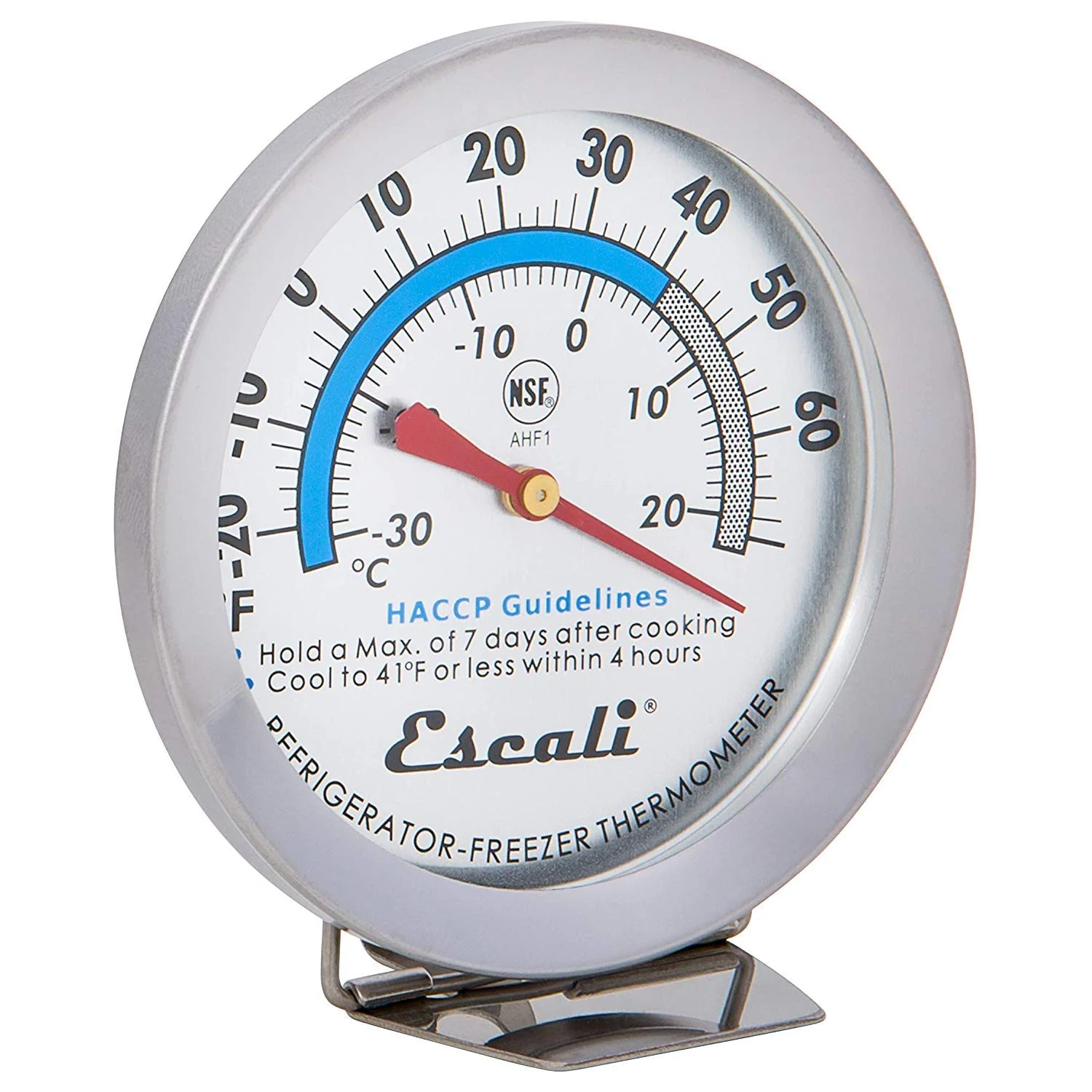
The AHF1 is the least exciting product of the three and the one most likely to keep food safe. It is a 2.875-inch stainless steel dial that reads from -20°F to 70°F, or -30°C to 20°C, with both scales on the face. Escali lists it at 10 inches long and 2.2 ounces.
You can stand it on a fridge or freezer shelf, or hang it from a rack with the articulating rear mount. Escali lists it as waterproof and freezer safe, and the power source as manual, so there is no battery to replace. The page describes no alarm and no memory for highs and lows, so the dial tells you the temperature now and nothing more.
Escali prints cold-holding temperature and time guidelines on the face, and colors a cold storage zone blue to show air at or below 41°F. Here we side with the FDA, which says to keep the refrigerator at or below 40°F (4°C). The blue zone ends one degree above that line, so read the needle and not the color.
For the freezer, the FDA says the temperature should be 0°F (-18°C). The dial's range takes in both the 40°F and the 0°F lines, so one model can serve either appliance. Escali names HACCP and NSF as specifications the dial meets.
Buyers use it in specific places. One hung it from the basket of a chest freezer in a garage and reads it without taking it down. Another keeps it in a mini fridge that houses a carbonation setup, so they know how cold the water runs.
One reviewer compared it with a cooking thermometer they describe as calibrated, and says both showed the same temperature. That buyer then used it to catch two portable fridges that were sold as reaching 36° and never got below 42°, which is above the FDA's 40°F line. Another reviewer has not checked it for accuracy but calls it perfect so far.
The written reviews we could read are few, four in all, and none is negative. The star breakdown shows more doubt: about 11 percent of ratings are one or two stars, so some buyers had a problem that the reviews we read don't describe. About 69 percent of ratings are five stars.
The limits are plain. The page does not say how finely the dial is divided or how accurate it is, so we would not read a one-degree difference from it. It is an analog dial, so it will not warn you when a door has been left open overnight.
Who should buy it: anyone with a chest freezer, a spare fridge or a mini fridge who wants a quick glance and no batteries. Who should skip it: anyone who wants alerts, a record of overnight highs or a screen outside the door, and would do better with a digital model. Escali lists a two-year product and parts warranty.
What buyers wrote about the Escali AHF1 Fridge Freezer Dial
5 out of 5 good purchase
accurate temp tested it with cookn thermos that r calibrated both displayed same temp and i like how you can hang it from a shelve or sit it upright good purchase happy with it 👍🏻unfortunately sent back two portable fridges that claimed 36° temps and never got under 42° so guage saved me from wasting money on the fridge cause i sent two of them back
Escali · four-event kitchen timer
Four timers, a count-up and a few setup snags
| In the box | Escali DR6 Four Event Digital Kitchen Timer, Standard, Black |
|---|---|
| Model | DR6 |
| Color | Black |
| Material | Plastic |
| Weight | 2.56 ounces |
| Size | 6"D x 3"W x 3"H |
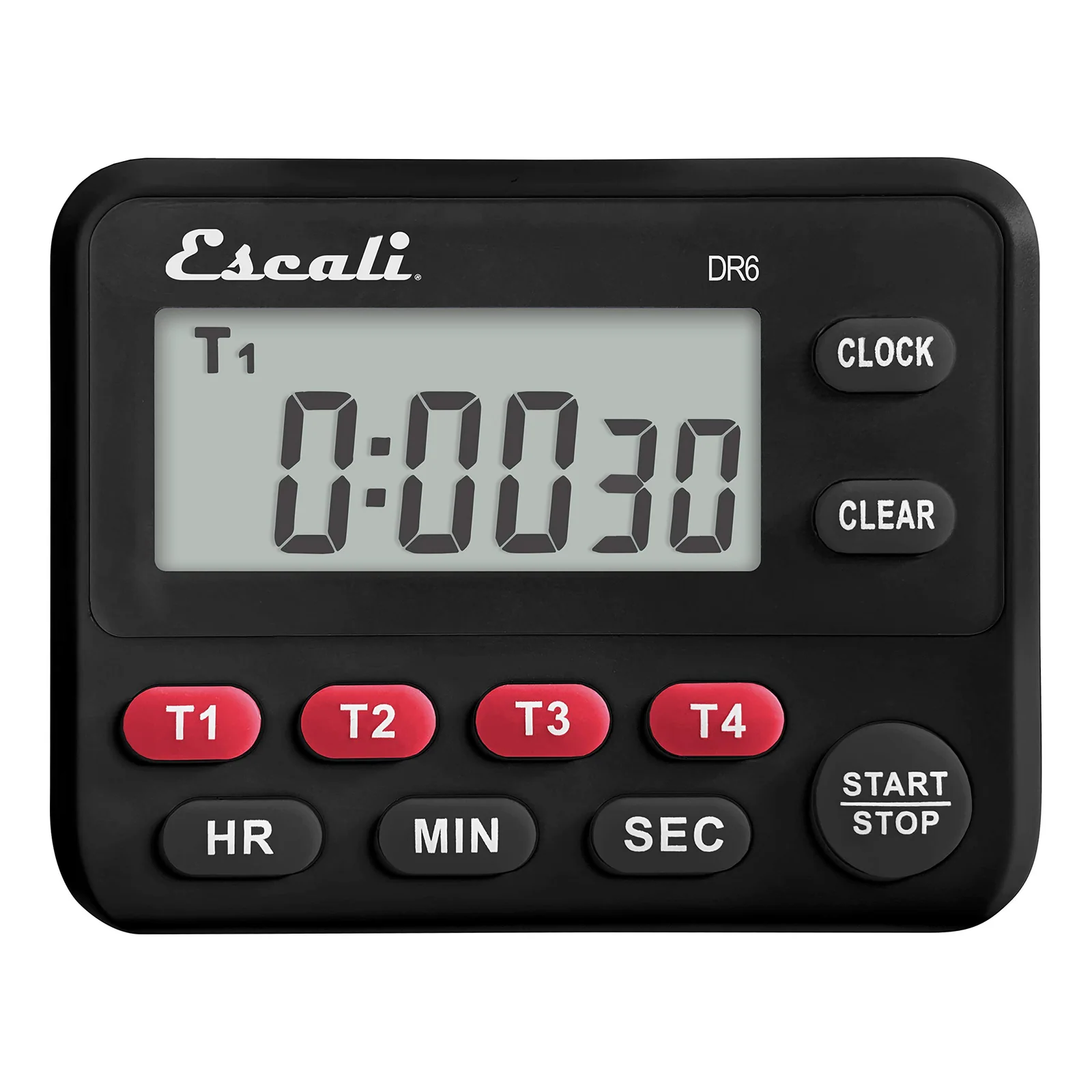
The DR6 is a plastic digital timer that weighs 2.56 ounces and runs on two AAA batteries, which Escali says are included. The range is up to 99 hours, 99 minutes and 59 seconds. Escali gives two sets of dimensions on its page, so measure your fridge door space if it is tight.
The bullet list says 3.5 by 3.75 by 0.75 inches, and the details list says 6 by 3 by 3.
The headline feature is four separate timers at once. A reviewer who often needs several timers while cooking called that the best feature. The DR6 also counts up and down, recalls the last setting, and works as a 12 or 24 hour clock.
The overtime counter is the quiet winner. After the alarm expires, the timer counts up until you press the Start/Stop button. One reviewer was delighted to see how long it has been since the alarm went off, the true time the item has sat in the oven.
Placement is flexible. Magnets on the back hold it to a refrigerator, a built-in kickstand props it on a counter, and a retractable tab hangs it from a wall. A reviewer put a lanyard through the tab to wear it around the neck while grilling, and says the two magnets hold firmly to a metal surface.
Setup and parts are the complaints. One reviewer gave four stars but received a unit with neither batteries nor the kickstand, though the packaging says both are included. Another gave three stars and calls it too complicated to set as a timer, so it works for them as a clock.
Alarm volume splits the reviewers. One found the alarm loud enough to annoy a family member, and another calls it quiet and likes that. If volume matters to you, expect either result, since the reviews don't agree and the specs give no decibel figure.
Support comes up once. A five-star reviewer's alarm stopped sounding, and they say Escali did not answer three emails before a new unit arrived. The reviewer says the limited warranty is not explained, and the specs we read give no warranty term.
The star breakdown reads like a decent but not outstanding product. About 66 percent of ratings are five stars, 11 percent are three stars, and about 10 percent are one or two stars.
Who should buy it: a cook with a roast, a pot and a tray of rolls all running together, who wants one device to track them. Who should skip it: anyone who times one thing at a time, or who dislikes learning a small control layout. A one-event timer will serve that person better.
What buyers wrote about the Escali DR6 Four Event Timer
4 out of 5 Some great features; make sure you get a complete item
I want to like this timer but I’m annoyed that I got an incomplete product. The one I got didn’t have the batteries OR the kickstand. The best feature of this device is the ability to time four different events at the same time. We often have to use multiple timers when cooking so this will come in very handy. Other nice features include the ability to count up or down, recall the last time, and use it as a regular clock with either 12 or 24 hour time. There are some other thoughtful features as well. There is a circular tab that the manufacturer calls a wallhanging tab but I put a lanyard on it and will hang it around my neck when grilling. There are also two magnets that are strong enough to hold it securely to a metal surface. Right now we have it on our refrigerator. The packaging says that there is a kickstand with the product but as noted above, mine didn't…
3 out of 5 Too complicated to set
Too complicated to use as a timer. I just use it as another digital clock. It's very quiet, which I like.
How the three differ on the facts
| Feature | Escali AHC2 Candy Thermometer | Escali AHF1 Fridge Freezer Dial | Escali DR6 Four Event Timer | Also in ToolsEscali DH1 Digital Thermometer | Also in ToolsEscali Stelo Folding Thermometer |
|---|---|---|---|---|---|
| Price | $16.95 | $16.95 | $21.95 | $21.95 | $69.95 |
| Rating | 4.4 of 5 | 4.4 of 5 | 4.3 of 5 | 4.3 of 5 | 4.7 of 5 |
| Ratings | 593 | 116 | 63 | 631 | 29 |
| Pieces | 1 Count | 1 Count | 1 Count | 1 Count | 1 Count |
| Best for | jam, pralines and deep frying in a deep pot | a chest freezer, spare fridge or mini fridge | cooks running several dishes at once | a first thermometer used on roasts and chicken a few times a month | cooks who check meat often and want a hold button and magnet |
These three do different jobs, so the comparison is about what each asks of you. The AHC2 asks you to trust a cheap dial and to own a pot deep enough for its probe.
The AHF1 asks for a glance and nothing more. The DR6 asks for a few minutes of setup and a battery check.
On temperature, the AHC2 and AHF1 sit at opposite ends. One reads 100°F to 500°F, the other -20°F to 70°F, and neither can stand in for the other. The DR6 tracks time, not temperature, and does it for four events at once, up to 99 hours.
On complaints, only the AHC2 draws accuracy reports: two in nine written reviews, plus one failure. The AHF1 has four short positive reviews, one of them describing a match with a calibrated cooking thermometer. The DR6's complaints are about missing parts and settings, and its one timekeeping comment says it is always accurate.
The five-star share runs 72 percent for the AHC2, 69 percent for the AHF1 and 66 percent for the DR6. The share of one and two stars is 7, 11 and 10 percent in the same order. The AHF1 has the cleanest written reviews and the highest share of low ratings, which is a reminder that four reviews are a thin base.
The two thermometers each list a two-year product and parts warranty. The DR6 specs we read list none. For meat instead of sugar, Escali's DH1 digital probe thermometer is reviewed separately.
Where another type would do better
A digital probe thermometer is better than the AHC2 when you want a number instead of a needle position. A dial needs a straight look at the face, and a number does not. The cost of going digital is a battery, and that is a fair price if you misjudge zones by eye.
Old glass-tube thermometers are the other option. One AHC2 reviewer, who had used a mercury-tube candy thermometer for years, found the Escali dial much easier to read and liked that it faces upward. A glass tube is better only when you already own one that you trust.
For the fridge, a built-in display is better when you never open the fridge to check it, since it is always in view. But a separate thermometer gives you a second opinion. The reviewer whose two portable fridges claimed 36° and never got below 42° found that out with a separate gauge.
A digital fridge thermometer is better when you need to read the temperature from outside the fridge, or want an alarm. The AHF1 does neither.
For the timer, a phone is better when you want many labelled timers and don't mind a screen in a greasy hand. An oven's own timer is better when you only time the oven. A one-event kitchen timer is better when simple setup matters more than tracking four things, and it avoids the setup complaint buyers made about the DR6.
What buyers say about the three
Escali AHC2 Candy Thermometer
4.4 (593 ratings) 50+ bought in past monthEscali AHF1 Fridge Freezer Dial
4.4 (116 ratings)Escali DR6 Four Event Timer
4.3 (63 ratings)We read 18 written buyer reviews across the three products: nine for the AHC2, four for the AHF1 and five for the DR6. That is a small base, so we lean on the star breakdowns too. About 72 percent of the AHC2's ratings are five stars, about 69 percent of the AHF1's and about 66 percent of the DR6's.
Praise for the thermometers is about reading and placing. Buyers like the dial that faces upward, the moving arrow on the AHC2 and the large face on the AHF1. Several say the clip or the rear mount holds the gauge where they need it.
Complaints cluster in three places. The AHC2 draws accuracy and failure reports, and the DR6 draws reports of missing parts and settings that are hard to learn. The AHF1 has no complaint in its written reviews, though about 11 percent of its ratings are one or two stars.
Support stories are mixed. One AHC2 buyer got a refund without returning the unit, and one DR6 buyer got a replacement after three unanswered emails. Neither is a reason by itself to buy or skip, but both show that a dud can be fixed if you ask.
I can see above the steam and see where heat is!!
Finally ... a timer that tells me how long it's been since the timer went off
Cold-holding temperature and time guidelines are included on the dial face for quick reference
Ratings, star breakdowns and “bought in past month” figures were read on the product pages on November 12, 2026.
How to check your fridge and freezer temperatures
A thermometer tells you something only when you compare it with a target. For the refrigerator, the FDA says to keep it at or below 40°F (4°C). For the freezer, the FDA says the temperature should be 0°F (-18°C).
The AHF1 can sit on a shelf or hang from a rack, so place it where you can read it easily. One reviewer hung theirs from a chest freezer basket and reads it without taking it down. Escali's blue zone ends at 41°F, one degree above the FDA line, so watch the needle against 40°F.
Check the thermometer itself before you trust it. The USDA Food Safety and Inspection Service describes an ice water method for food thermometers and says the reading should be 32 degrees F. Escali's pages give no calibration steps for the AHF1 or the AHC2, so a gauge that misses the mark is a reason to return it.
For the AHC2, the boiling water method is the second one the USDA describes. It says the thermometer should read 212 degrees F at sea level. That line is for sea level, and we have no source for other altitudes.
- Stand the AHF1 on a shelf or hang it from a rack with the rear mount.
- Read the needle against the FDA targets: 40°F or below in the fridge, 0°F in the freezer.
- Ignore the blue zone's edge at 41°F and use 40°F instead.
- Check a thermometer in ice water, where the USDA says it should read 32°F.
- Check the AHC2 in boiling water, where the USDA says 212°F at sea level.
- Return any thermometer that misses the mark, since Escali gives no adjustment steps.
Our verdict on the three
Recommended, with caveats
Escali AHC2 Candy Thermometer
Useful zones and a clip, but three of nine written reviews report a wrong or failed unit, so check it in ice water first.
Shop It on AmazonWe recommend
Escali AHF1 Fridge Freezer Dial
A wide-range dial that stands or hangs, with only positive written reviews, as long as you read it against the FDA numbers.
Shop It on AmazonRecommended, with caveats
Escali DR6 Four Event Timer
The four events and the count-up after the alarm are useful, but buyers report missing parts and settings that take learning.
Shop It on AmazonWe recommend the AHF1 without much hedging. It is a plain dial with a range of -20°F to 70°F, easy to hang or stand, and the written reviews we read are all positive. Read the needle against the FDA's 40°F and 0°F targets and not the blue zone's 41°F edge.
The AHC2 gets a conditional. The zones and the long probe suit jelly, pralines and frying, and about 72 percent of ratings are five stars. We would still run an ice water check first, because three of nine written reviews report a failed or inaccurate unit.
The DR6 also gets a conditional. Four events and a count-up after the alarm are useful for a cook with several dishes going. We would not recommend it to anyone who times one thing at a time, or who dislikes learning a small control layout.
We don't recommend the AHC2 for a shallow pot, since a reviewer found it top heavy there and another wrote that the smaller size is better for a regular saucepan. We don't recommend the DR6 if a missing battery or kickstand would sour you, since one buyer got neither.
If you buy only one, buy the AHF1 and use the FDA numbers. If you fry or make candy, add the AHC2 and check it in ice water on day one. Add the DR6 only if your recipes overlap.
Questions buyers ask
What temperature should a refrigerator be?
The FDA says to keep the refrigerator at or below 40°F (4°C). The Escali AHF1 reads from -20°F to 70°F, so it covers that line. Its blue zone is marked at or below 41°F, one degree above the FDA's number, so read the needle against 40°F.
What temperature should a freezer be?
The FDA says the freezer temperature should be 0°F (-18°C). The Escali AHF1 reads down to -20°F, so 0°F sits inside its range. One reviewer hung theirs from the basket of a chest freezer in a garage and reads it from there.
Is the Escali AHF1 good for a chest freezer?
Yes, one reviewer bought the AHF1 for a garage chest freezer and says it hangs off the freezer baskets and is easy to read without taking it off. Escali lists the dial as freezer safe and waterproof, with a 10-inch length and a rear mount for hanging.
How do I check whether a thermometer is accurate?
The USDA Food Safety and Inspection Service describes two ways to check a food thermometer, one with ice water and one with boiling water. In ice water it should read 32 degrees F. In boiling water it should read 212 degrees F at sea level.
Is the Escali AHC2 candy thermometer dishwasher safe?
Escali's page says both things. One bullet calls the AHC2 dishwasher safe, while the details list says hand wash only. We would hand wash it. A reviewer adds that food can lodge in the clip, and a small brush clears it.
Which is better for making jelly, the Escali AHC2 or the DR6 timer?
The AHC2 is better for jelly, because it shows temperature and has a jelly zone and an adjustable arrow on its dial. One reviewer who makes jelly praises exactly that arrow. The DR6 tracks time, up to 99 hours, so it is a companion and not a substitute.
Does the Escali DR6 timer come with batteries?
Escali's page says two AAA batteries are included. One reviewer, though, received a DR6 with neither batteries nor the kickstand, even though the packaging said both were in the box. If yours arrives without them, expect to buy AAA cells and contact Escali.
Sources
This review covers food safety. It is general information, not professional advice: follow the agency guidance and your appliance's manual.
- Are You Storing Food Safely?, U.S. Food and Drug Administration. Read November 12, 2026.
- Kitchen Thermometers, USDA Food Safety and Inspection Service. Read November 12, 2026.
Read next
More from Kitchen Tools
Tools · 4 products
Kitchen Scales Compared: Escali Digital, Glass and Dial
Four Escali scales, three designs and one clear split: big capacity, fine readout or no batteries at all.
Tools · 3 products
Escali Meat Thermometers Compared: Probe, Folding, Wireless
Three Escali thermometers answer three different cooks: the quick check, the rechargeable pocket tool and the long roast you leave alone.
Tools · 5 products
LIVINGO Kitchen Shears Reviewed: Five Pairs and Sets Compared
Five LIVINGO shears, one forged pair that comes apart, and one poultry shear we would pass on: here is what the specs and buyers say.